
Lattice GAL18V10B-15LJ: Architecture, Key Features, and Target Applications
The Lattice GAL18V10B-15LJ represents a specific member of the long-standing and highly successful Generic Array Logic (GAL) family of programmable logic devices (PLDs). As a modern iteration of this classic architecture, it provides a reliable and cost-effective solution for a wide range of glue logic and logic integration applications. Its enduring popularity is a testament to a design that effectively balances flexibility, performance, and ease of use.
Architecture: A Classic PLD Structure
The GAL18V10B-15LJ is built around a well-defined PLD architecture. The "18" in its name denotes the number of inputs, while the "10" refers to the number of outputs. Its core consists of a programmable AND array followed by a fixed OR array. This structure allows users to create a multitude of sum-of-products logic functions.
A key architectural feature of this device is its Output Logic Macrocell (OLMC). Each of the ten output pins is controlled by its own macrocell. These macrocells are highly configurable, allowing each output to be programmed as a dedicated input, a registered (clocked) output, or a combinatorial output. This flexibility is crucial for implementing various state machines and complex combinatorial logic. The macrocells are configured using electrically erasable (E2) CMOS technology, which allows the device to be reprogrammed multiple times, facilitating rapid design iteration and prototyping.
Key Features and Performance
The GAL18V10B-15LJ-15LJ suffix specifies a maximum pin-to-pin propagation delay of 15 ns, making it a relatively high-speed component for its category. This performance is suitable for bridging timing gaps between larger, slower components in a system.
Other standout features include:
High Output Current: Capable of sourcing 24 mA or sinking 48 mA, enabling it to drive LEDs and other high-current devices directly without needing external buffer chips.
Low Power Consumption: Utilizing an advanced CMOS process, it operates with significantly lower power than its bipolar (e.g., PAL) predecessors.
Programmable Output Polarity: Each output can be configured for active-high or active-low operation, simplifying logic design and reducing the need for external inverters.
High Reliability: The device features robust electrostatic discharge (ESD) protection and a wide operating voltage range.
Target Applications
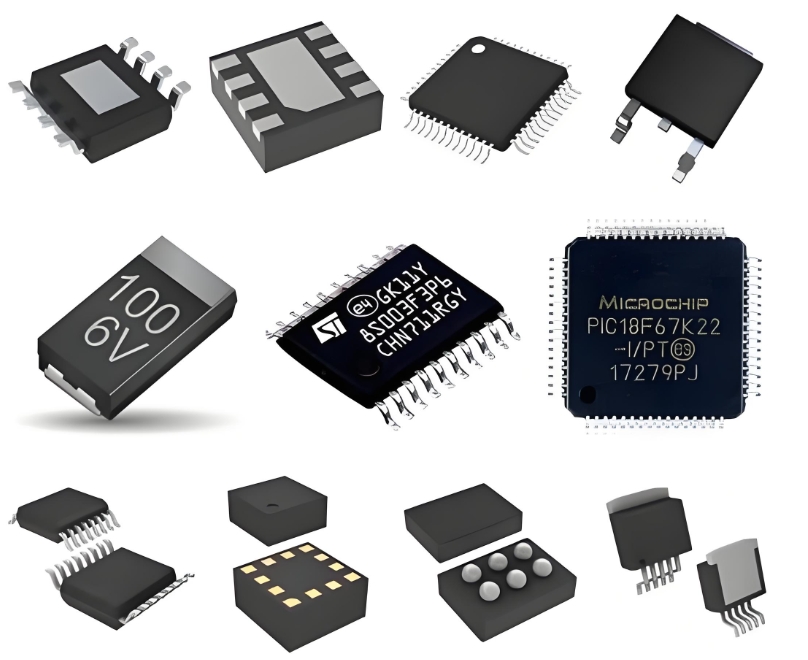
The GAL18V10B-15LJ excels in applications that require the integration of multiple simple- to medium-complexity logic functions into a single chip. Its primary role is often as "glue logic," interconnecting larger-scale integrated circuits like microprocessors, memory, and ASICs.
Specific target applications include:
Address Decoding: Generating chip select signals for memory and peripheral ICs in microprocessor-based systems.
State Machine Control: Implementing finite state machines (FSMs) for simple control sequences.
Bus Interface Logic: Acting as an interface between buses with different protocols or timing requirements.
I/O Expansion and Conditioning: Decoding I/O ports and providing necessary signal conditioning for switches, LEDs, and relays.
System Configuration and Control: Integrating "random" logic that would otherwise require numerous small- and medium-scale integration (SSI/MSI) fixed-function ICs.
The Lattice GAL18V10B-15LJ remains a highly relevant component for engineers seeking a straightforward, reliable, and cost-efficient PLD solution. Its blend of a simple architecture, flexible macrocells, robust drive capability, and reprogrammability makes it an indispensable tool for logic consolidation and system control in both modern and legacy electronic designs.
Keywords:
Programmable Logic Device (PLD)
Generic Array Logic (GAL)
Output Logic Macrocell (OLMC)
Glue Logic
Electrically Erasable (E2) CMOS Technology

