
Lattice GAL16V8D-15QJ: Architecture, Features, and Application in Digital Logic Design
The Lattice GAL16V8D-15QJ stands as a seminal device in the history of programmable logic, representing a highly popular and influential Generic Array Logic (GAL) device. As an advanced successor to the rigid PAL (Programmable Array Logic) architectures, the GAL16V8D offered a revolutionary combination of reprogrammability and flexible logic implementation, which became a cornerstone for countless digital designs in the late 20th century.
Architecture: A Look Inside
The architecture of the GAL16V8D is a masterpiece of programmable logic design. Its name provides a clear breakdown of its core structure: "16" indicates the number of dedicated inputs, "V" signifies a versatile output logic macrocell, and "8" denotes the number of available outputs. The "-15" suffix specifies a maximum pin-to-pin propagation delay of 15 nanoseconds, a key speed grade for its era.
The device is centered around a programmable AND array followed by a fixed OR array. The programmable AND array allows users to create any desired combination of product terms (minterms) from the input signals. These product terms are then fed into the Output Logic Macrocell (OLMC), the true heart of the GAL's flexibility.
Each of the eight OLMCs can be individually configured by the user into multiple operational modes:
Combinatorial Output: The output is a direct function of the input logic.
Combinatorial I/O: The pin can act as an input or an output based on the logic function.
Registered Output: The output is stored in a D-type flip-flop on the rising edge of the clock signal, enabling the implementation of sequential logic circuits like counters and state machines.
This reconfigurability meant a single GAL16V8D could replace dozens of fixed-function TTL (Transistor-Transistor Logic) ICs, drastically reducing board space, power consumption, and system cost.
Key Features and Advantages
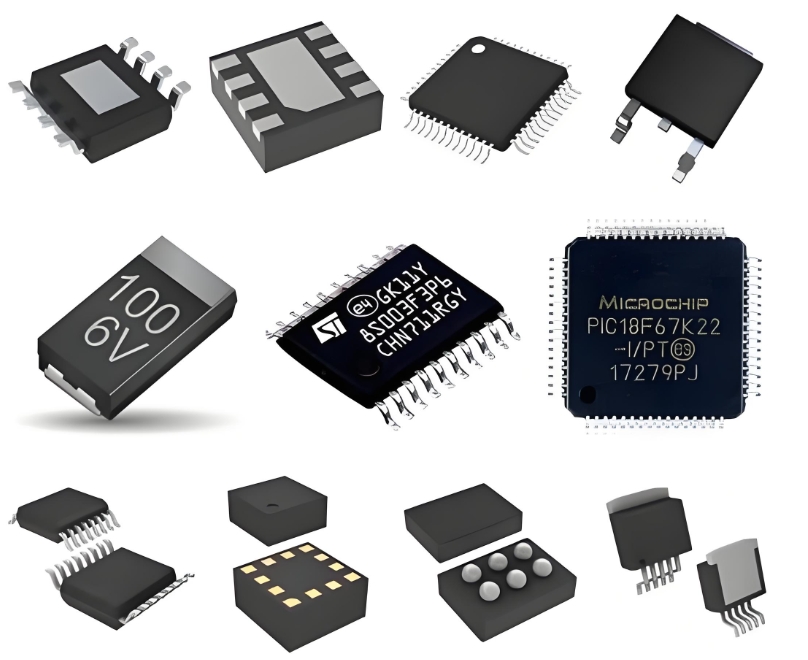
The GAL16V8D-15QJ, packaged in a plastic leaded chip carrier (PLCC-20), offered a set of features that made it exceptionally popular:
Electrically Erasable (E²) CMOS Technology: Unlike one-time programmable (OTP) PALs, the GAL16V8D could be erased with ultraviolet light or electrically (depending on the variant), allowing for design iteration and code reuse.
100% Testability: The built-in logic provided for complete functional and AC parametric testing.
High Reliability: The use of CMOS technology resulted in lower power consumption and a wide operating voltage range compared to bipolar alternatives.
Security Fuse: A programmable security bit prevented unauthorized copying of the configured logic pattern, protecting intellectual property.
Application in Digital Logic Design
The primary application of the GAL16V8D was in glue logic integration. Designers used it to replace collections of simple gates, decoders, multiplexers, and flip-flops that were responsible for interfacing ("gluing") between larger digital components, such as microprocessors, memory ICs, and peripherals.
Its ability to implement both combinatorial and registered logic made it ideal for a vast array of functions, including:
Address decoders and bus interfaces
State machines for simple control units
Data routing and multiplexing logic
Counter and timer modules
Customized waveform generators
While largely superseded by more complex CPLDs and FPGAs today, the GAL16V8D was an essential tool for learning the fundamentals of Hardware Description Languages (HDLs) like CUPL and Abel, which were used to program these devices. It served as the perfect bridge between discrete logic and high-density programmable logic.
The Lattice GAL16V8D-15QJ was a transformative workhorse of digital design, whose architecture of programmable AND arrays and versatile output macrocells set the standard for low-density programmable logic. Its impact on simplifying PCB design, accelerating prototyping, and educating a generation of engineers remains significant.
Keywords:
Programmable Logic Device
Output Logic Macrocell
Glue Logic
Hardware Description Language
Reconfigurable

